A gate agent in Frankfurt once made me put my perfectly normal, U.S.-standard carry-on into a metal sizing frame while a line of German business travelers stood there checking their watches. It fit—barely—but only because I’d looked up Lufthansa’s numbers in a hotel room the night before, not because I assumed every airline plays by the same rules as Delta or United. “22 x 14 x 9” is an American consensus, not a global law, and nobody tells you that until you’re the one holding up the line.
I built this chart after that trip, mostly so I’d stop pulling up eleven different airline sites on hotel wifi that drops every four minutes. My old system was a folded printout that lived in a bag pocket until it got soaked on a rainy tarmac in Cleveland and turned into gray pulp—RIP to that bag too, a mid-tier spinner that started delaminating at the corners before its first birthday. These days I keep the real numbers here instead, pulled straight from each carrier’s own baggage page where that’s actually possible, and from a source that loads and says the same thing when an airline’s site is more interested in blocking robots than answering a simple question. Pack to the tightest number on your itinerary, not the most generous one, and you won’t be the one sweating in the sizer.
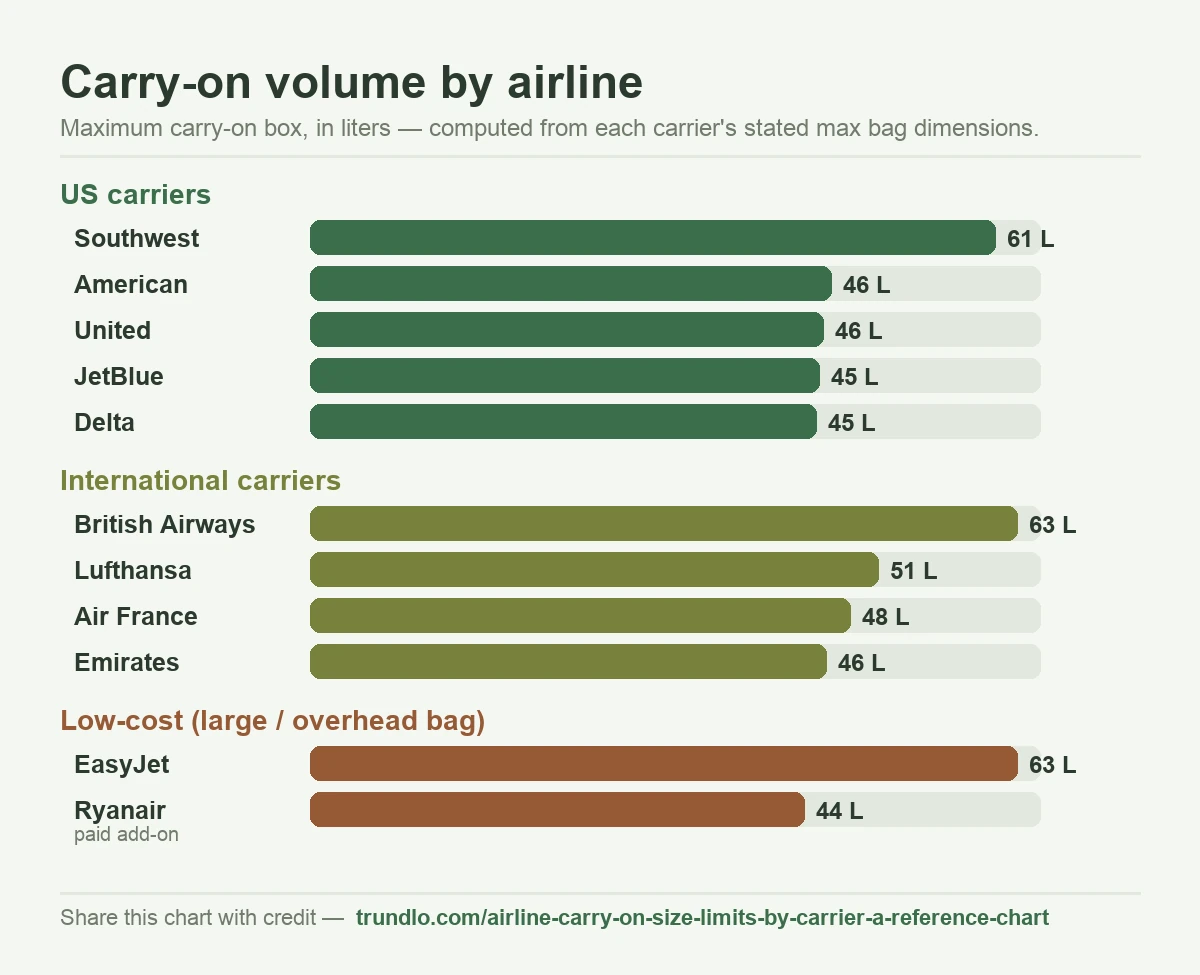
The one rule: pack to the tightest number on your whole itinerary, not the most generous one — a bag that sails through a 61 cm Southwest gate can still get pulled at a Lufthansa (55 cm) or Emirates (55 cm) sizer.
Major US Carriers
| Airline | Max Dimensions (Inches) | Max Dimensions (CM) | Weight Limit | Notes |
|---|---|---|---|---|
| American Airlines | 22 x 14 x 9 in [1] | 56 x 36 x 23 cm | No official limit | Dimensions include wheels and handles; no official weight cap, but you’re the one who has to lift it into the bin. |
| Delta Air Lines | 22 x 14 x 9 in [2] | 56 x 35 x 23 cm | No limit on most routes | Weight limits only kick in on flights out of a few Asian hubs—Singapore caps it at 7 kg (15 lbs), Beijing/Shanghai at 10 kg (22 lbs). [3] |
| United Airlines | 22 x 14 x 9 in [4] | 56 x 35.5 x 23 cm | No official limit | Basic Economy usually includes a personal item only, no overhead-bin bag, on most routes. |
| Southwest Airlines | 24 x 16 x 10 in [5] | 61 x 40 x 25 cm | No limit | Dimensions run bigger than the 22 x 14 x 9 in most other US carriers use. |
| JetBlue | 22 x 14 x 9 in [6] | 55.88 x 35.56 x 22.86 cm | No weight restriction | Blue Basic fares have included a free carry-on bag since September 6, 2024. [7] |
International Carriers
| Airline | Max Dimensions (CM) | Max Dimensions (Inches) | Weight Limit | Notes |
|---|---|---|---|---|
| British Airways | 56 x 45 x 25 cm [8] | 22 x 18 x 10 in | 23 kg (51 lbs) | Weight limit applies to each individual cabin bag, not combined with your personal item. [9] |
| Lufthansa | 55 x 40 x 23 cm [10] | 21.6 x 15.7 x 9 in | 8 kg (17 lbs) | Weighed and measured more strictly than most US carriers; foldable garment bags up to 57 x 54 x 15 cm are also permitted. |
| Air France | 55 x 35 x 25 cm [11] | 21.7 x 13.8 x 9.9 in | 12 kg (26.4 lbs) | Weight limit is the combined total of your carry-on and personal item. |
| Emirates | 55 x 38 x 22 cm [12] | 22 x 15 x 8.5 in | 7 kg (15 lbs) | Economy gets one carry-on bag; Business and First add a 7 kg briefcase or garment bag on top of it. |
Low-Cost Carriers
| Airline | Small Bag (Free) | Large Bag (Paid/Priority) | Weight Limit | Notes |
|---|---|---|---|---|
| Ryanair | 40 x 30 x 20 cm [13] | 55 x 40 x 20 cm | 10 kg (Large bag) | Small bag must fit under the seat; large bag requires the “Priority & 2 Cabin Bags” add-on. |
| EasyJet | 45 x 36 x 20 cm [14] | 56 x 45 x 25 cm | 15 kg (Small bag) | Small bag is free for everyone; large bag comes with a FLEXI fare or easyJet Plus membership, or as a paid add-on. |
Key Definitions
- Carry-On Bag (Cabin Bag)
- A piece of luggage intended for storage in the overhead bin. Standardized dimensions typically hover around 22 x 14 x 9 inches (56 x 36 x 23 cm) for US domestic flights.
- Personal Item
- A smaller bag (e.g., purse, laptop bag, small backpack) that must fit entirely under the seat in front of the passenger. Typical limits are approximately 18 x 14 x 8 inches (45 x 36 x 20 cm).
- Combined Weight
- A policy used by some international carriers (e.g., Air France) where the weight of the carry-on bag and the personal item are added together to meet a single maximum threshold.
- Sizer
- A metal frame located at airport check-in counters or gates used to verify that a bag meets the airline’s specific dimensional requirements—the same frame that had my carry-on (and my patience) tested in Frankfurt.
I re-check these numbers every few months since airlines shuffle them without much warning. If a link above ever 404s on you, assume the carrier changed something and go check their current page before you fly—don’t just trust the last number you saw here.
Last verified: 2026-07-17
Sources
- [1] KAYAK: American Airlines carry-on size
- [2] Delta Air Lines: Carry-On Baggage
- [3] CabinZero: Delta Airlines Baggage Allowance
- [4] KAYAK: United Airlines carry-on size
- [5] My Baggage: Southwest Airlines Baggage Allowance
- [6] JetBlue: Carry-On Bags
- [7] SmarterTravel: JetBlue Makes Carry-On Bags Free for Blue Basic
- [8] KAYAK: British Airways carry-on size
- [9] Send My Bag: British Airways Baggage Allowance
- [10] KAYAK: Lufthansa carry-on size
- [11] Send My Bag: Air France Baggage Allowance
- [12] KAYAK: Emirates carry-on bag size guide
- [13] My Baggage: Ryanair Baggage Allowance
- [14] Travellon: easyJet Baggage Allowance Guide