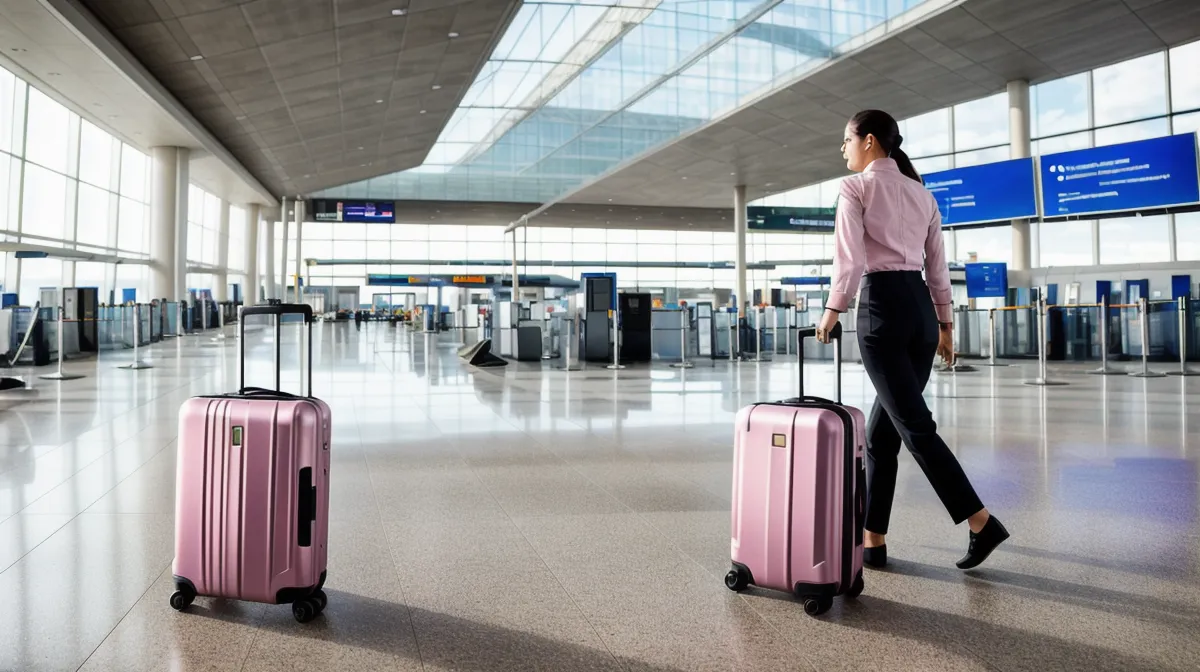
Four pink gate-check tags in six weeks, same bag, four different departure gates out of Indianapolis, and by the third one I'd started keeping a tally on the inside of my boarding pass sleeve. That's the stretch of business travel that finally made me stop treating carry-on durability as a marketing word and start treating it as a problem created by airline policy on purpose. Every one of those tags meant the same short trip down a jetway ramp, and every one of those flights came home with a slightly worse bag than it left with.
Quick disclosure before the wheel autopsy: this site runs on affiliate links, and buying a bag or a shipping plan through one of mine earns me a small commission at no extra cost to you. I point people toward brands like Briggs & Riley because I've watched them survive the exact abuse I'm about to walk through, not because anyone paid for the recommendation.
What Gate-Check Policy Actually Does Once the Bag Leaves Your Hand
Airlines love the word valet for this. It sounds like someone in white gloves setting your suitcase on a velvet shelf, when what actually happens is closer to being thrown into a pool without knowing how to swim. Hand a bag over at the end of the jetway and it doesn't wait politely; it goes down a metal slide or a steep ramp, often picking up enough speed to collide with whatever bag went down ahead of it. Most of us buy a carry-on sized to the standard domestic carry-on dimensions because it's supposed to ride with us, not get freighted. Once it's gate-checked, that same bag ends up stacked at the bottom of a cargo hold on something like a CRJ200, where the ceiling is low, the floor is cold, and twenty other overstuffed bags are counting on yours to hold their weight.
Regional jets out of Indianapolis make this a scheduled inevitability rather than bad luck. My neighbor Denny, who spent years doing logistics consulting before going fully remote, keeps an actual spreadsheet ranking carriers and hub airports by how aggressively they enforce carry-on sizing, updated after every trip he takes; regional connections sit near the top of his list for guaranteed gate-checks, and Indianapolis shows up more than he'd like. Regional jet bins are sized like they were built for a laptop sleeve and a prayer, not a real 22-inch spinner, which is half of why the sizing charts you find online never quite match what happens at the actual gate.
Why Wheels Give Out Before Zippers Do
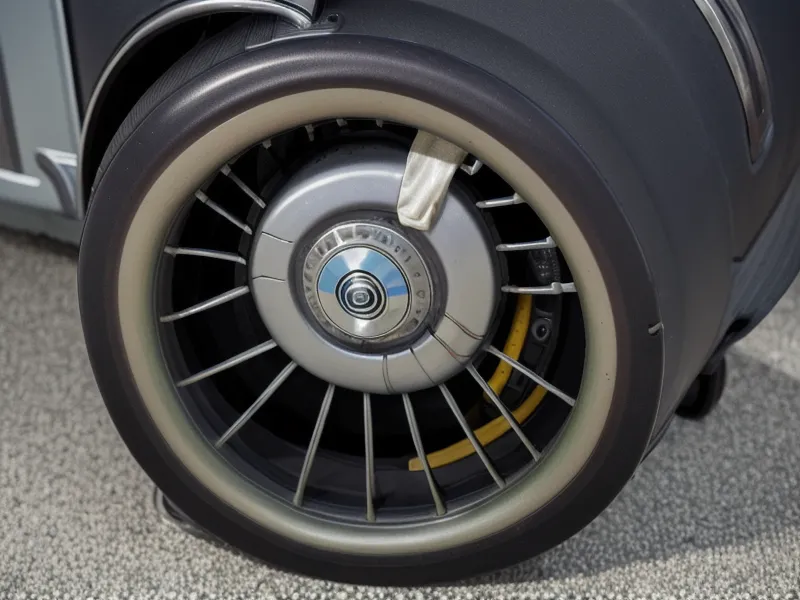
Wheels are the first casualty, and they're a bit like a kitchen knife, a precision tool that works beautifully when it's used the way it was designed, on smooth terminal floors with the 360-degree rotation range built for tight corners, not for being dragged sideways across a cargo hold. The failure mode is lateral shear: a wheel catches on a floor seam or the edge of another bag while it's getting shoved into a stack, and if the housing is brittle plastic sitting in a cold hold, that housing can shear clean off. Wheels come in roughly four grades depending on bearing quality and housing material, and gate check finds the weak one in that lineup fast.
A reader named Clifton, who's emailed me on and off since a wheel blew out on him in Phoenix, keeps a log of failures sorted by the floor surface at each airport; polished terrazzo wears a wheel down differently than a rough concrete apron, and a cargo hold floor is arguably worse than both because it's uneven, cold, and moving under load for the whole taxi. That thwack-thwack-thwack you hear from a flat-spotted wheel on a long terminal walk afterward is basically that damage announcing itself.
Zippers fail for a related but different reason. We think of them as binary, open or closed, but they're under constant tension, and when a bag sits at the bottom of a stack, the weight pushes the sides outward and pulls sideways on the teeth until the coil gives out. That's the burst-pressure problem I get into properly in why I only buy luggage with YKK zippers, so I won't repeat the whole case here. A derailed zipper can sometimes be walked back onto its track with nothing but a hotel pen and patience, though that's a field repair for a calmer day than the one you're usually having when it happens.
The Regional Jet Squeeze
Following the 3-1-1 liquid rule and packing like a minimalist doesn't save you from any of this if the plane itself won't take your bag. For a business traveler working a tight connection, that's not an inconvenience, it's a threat to the schedule; you can't stand at the jetway for ten minutes waiting for the valet cart to unload when the meeting starts the moment you land. Every extra cubic inch of packing capacity is a weight-versus-capacity trade you're making whether you notice it or not, and gate check punishes the heavy end of that trade hardest.
The CX expansion system is the one frame reinforcement I've found that actually holds up under stacked-bag weight instead of just buying extra zipper capacity, which matters more than showroom looks once you know gate check is coming. If you're hauling a suit instead of folded shirts, that's a different transport problem entirely; the short version is a garment bag survives gate-check even worse than a spinner does, so I treat that as its own packing decision rather than an afterthought.
Eight Weeks of Actually Noticing the Difference
Before this bag, I ran a cheaper spinoff line from a brand whose flagship I'd otherwise trusted, on the theory that it was basically the same construction for less money. The wheels started grinding audibly by month five, and by month seven one of them had the same flat-spotted thwack Clifton logs in his spreadsheet. Somewhere around week eight of flying with the reinforced replacement instead, I hoisted it into the overhead bin at a connecting gate and realized my shoulder hadn't done its usual small wince; the bag just went up, lighter than my hands expected, and I only noticed because the absence of that wince was the strange part.
That failed wheel went into a small pile I've started keeping on a pegboard in the spare bedroom I converted into a staging area for test gear — old axles and zipper pulls from bags that didn't make it, next to a rolling rack where whatever I'm currently flying with waits between trips. It's not glamorous, but it's turned into a decent gauge of real luggage durability instead of showroom looks.
So Which Bag Actually Survives Gate Check?
None of this means gate check is avoidable; planes keep getting fuller and bins aren't getting bigger, so the real question is which gear survives the process instead of which gear just claims to. The bag that's earned a permanent spot in my rotation is Briggs & Riley, mainly because their lifetime warranty explicitly covers airline-handler damage instead of quietly excluding it the way most fine print does; you don't appreciate that kind of coverage until a wheel shears off in a cargo hold and the brand just fixes it instead of asking whether you really needed to gate-check in the first place.
For trips carrying more than a single carry-on's worth of gear, I reach for Luggage Forward instead, shipping bags door-to-door so they skip the jetway slide entirely; the tradeoff is cost and a few days of transit buffer, so it only pencils out once you're past what one spinner can hold. The flip side of shipping ahead is that someone has to be there to receive it, which is its own small logistics puzzle at an unfamiliar hotel front desk.
Travelpro is the carry-on flight crews have leaned on for years, about as close to real-world torture testing as this industry gets, and Travelpro is a solid pick if you want an actual bag you'll gate-check more often than you'd like. The brand alone sells something like three tiers of the same basic bones, and which tier you land on changes how much abuse it can take. For more crush-resistance than soft-side construction offers, LEVEL8's aluminum-shell models trade the flex a polycarbonate shell has for a dent that never pops back out, which is either a dealbreaker or exactly the durability you want depending on how your bag usually gets treated. It's basically the hardshell-versus-softside argument again; a hardshell shrugs off a corner impact the way a skillet shrugs off a dropped spoon, while a softside absorbs it and hopes for the best.
My actual packing system is a separate conversation, but none of it matters if the bag underneath it can't survive the trip to baggage claim; that's the one lesson eight weeks of paying attention actually taught me: judge a carry-on by what it does at the bottom of a cargo hold, not by how it looks rolling through the terminal. If you're tired of the thwack-thwack of a broken wheel, the Briggs & Riley Baseline collection is where I'd start looking. Safe travels, and may your connections always be long enough to watch your own bag come down the jetway ramp.