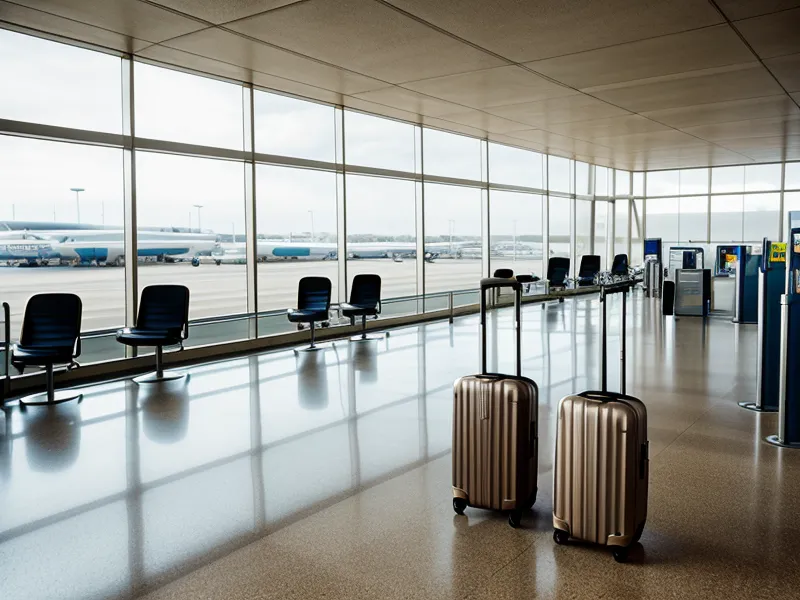
I'm speed-walking down the H concourse at O'Hare, gate already boarding, and the bag beside me is just rolling — no catch on the carpet seam, no drift toward the wall, nothing I have to correct for with my wrist. Three gates later it actually registers: I haven't thought about this bag once. On a business travel schedule that doesn't forgive a bag that quits, carry-on luggage durability isn't an abstract idea to me — it's just the job.
Before anything else: some of the links below are affiliate links, and if you buy carry-on luggage or a shipping service through them, I earn a small commission at no cost to you. Nothing on this list is here because a brand asked nicely — it's here because I dragged it through actual airports on actual work trips.
The Hardshell-Beats-Softside Myth Doesn't Survive a Regional Jet
Ask five people waiting at a gate which carry-on lasts longer and four will say the hardshell. A hard case just reads as tougher than fabric, the same instinct that makes a countertop appliance in a metal shell feel more serious than a plastic one. It's a comfortable belief, and after watching carry-on luggage die on the regional circuit for years, I can tell you it's wrong: shell material isn't what decides how long a bag survives business travel. The wheels, the zipper, and the handle mechanism decide that, almost every time, and the right shell is just whichever failure mode you'd rather live with.
Living in suburban Indianapolis means most of my connections run through small regional jets — CRJs and ERJs with overhead bins built for a laptop bag and not much else. Anything bigger gets gate-checked, tossed onto a cart, rained on, and stacked in a cargo hold by someone with four minutes to turn the plane around. That's the environment the myth actually gets tested in, and it's brutal on both shell types in completely different ways.
Picture the choice less like good bag versus bad bag and more like a cast iron skillet against a nonstick pan. Cast iron shrugs off scratches and heat that would ruin a nonstick coating, but drop it wrong on tile and a corner can chip cleanly off: no bending, no give, just a crack. A softside bag is closer to the nonstick: it flexes, it absorbs a bad landing on a conveyor belt, and it rarely just breaks in half. But the same softness that saves it from a hard drop is exactly what lets seams fray and zipper teeth start skipping after a couple of years of being stuffed one shirt past comfortable. A hardshell fails suddenly, at a single stress point, usually a corner. A softside fails gradually, at the stitching and the zipper track. That's the whole myth, dismantled: the question was never which shell is "tougher" — it's which failure mode you'd rather manage.
There's a specific vibration that gives away a wheel axle that's gone loose but hasn't failed yet; you feel it climb up through the handle grip before you ever hear the rattle, a little telegraph tapping out a warning on smooth airport tile. That's true no matter which shell the wheel is bolted to. The shell was never the part doing the failing in the first place; the wheels, the zipper, and the telescoping handle mechanism are where a bag actually dies, and none of those three care whether the case around them is polycarbonate or ballistic nylon.
Four Failures That Have Nothing to Do With the Shell
A no-name spinner I bought off Amazon years ago cracked a wheel casing on only its second trip, and an uneven stretch of cobblestone outside a downtown hotel finished the job — one wheel started rolling at an angle, dragging sideways every few feet like a shopping cart with a bad caster. That's an inline-wheel failure on uneven ground, and it's rarely about the shell. It's almost always a cheap axle housing that was never rated for anything rougher than airport tile.
Zippers fail their own way. One softside bag I traveled with for exactly one bad year had a zipper pull snap clean off mid-trip, on a closure that was already fighting to shut over one too many rolled sweaters — and once a pull is gone, you're working a keyring split-ring through a tiny metal loop in a hotel room the night before a client meeting. Now I check the zipper pull for a brand stamp before I look at anything else on a bag; an unbranded zipper on an otherwise decent case is about the fastest predictor there is of the failure that eventually ends it, and that's really its own conversation about zipper hardware, not a footnote here.
Hardshells crack differently, and I watched it happen in real time on a jet bridge in the middle of a heat wave — the bag caught the lip of the ramp wrong, hit the corner first, and that corner simply gave, a hairline split running up from the wheel housing like an eggshell fracturing. Heat had softened the polycarbonate just enough to lose its usual snap-back, and a drop that would've only scuffed a softside bag turned into a repair I couldn't do myself.
Handles have their own way of quitting. A telescoping handle on another bag got stuck halfway between click positions on a connection through Charlotte, refusing to lock at full height or retract flush, so I spent a layover holding it at an awkward crouch-walk height rather than miss the next boarding call to fight with it. None of that has anything to do with whether the shell is hard or soft. It's a mechanism problem, and mechanisms fail regardless of what's wrapped around them.
So the actual rule: stop deciding hardshell versus softside first. Decide which failure you can tolerate (a sudden corner crack you can't fix yourself, or a slow zipper-and-seam decline you can) and only then let that answer point you toward a shell. After that, check the wheel axles, the zipper pull, and the handle mechanism before you care what the outside is made of, because that's where a bag on a punishing schedule actually gives out.
Two Bags, Two Very Different Failure Modes
Two bags made this concrete for me over about six months of back-to-back trips. First was a Travelpro softside from the Maxlite line, the one flight crews have run through jetways for years, which is about the closest thing to real-world torture testing this industry has. Mine held up exactly like that reputation promises — light, plain-looking, and built with wheels and handle parts easy enough to replace that a broken caster never once threatened to retire the whole bag. Whether the extra money for a sealed spinner axle over a basic caster is worth it at checkout is its own wheel-construction rabbit hole, one that deserves more room than a paragraph here. Travelpro's own lineup climbs well past the Maxlite, too, and deciding how far up toward the Platinum Elite tier to go is a separate question I've answered elsewhere.
Then came a LEVEL8 aluminum-frame hardshell for a run of early spring trips, and the first thing you notice is the sound it doesn't make — a sharp, contained click of the spinner wheels on tile instead of the rattle-hum most budget hardshells produce. It reads expensive because the wheel bearings actually are precise, not because the shell is magic. Aluminum doesn't forgive the way polycarbonate does, though: a polycarbonate corner will often flex back from a bump that would leave aluminum with a permanent dent, so every scuff on the LEVEL8 stays a scuff forever. How that aluminum shell is actually built — the seam work, the corner extrusions — is worth a much longer look than I can give it in a durability roundup. And gate-checking is exactly where a hardshell's dent-versus-crack tradeoff gets tested hardest, which is a big enough subject to deserve its own post rather than a throwaway line here.
Is the Premium Jump to Briggs & Riley Actually Worth It?
A heavy-gear trip to Minneapolis is what actually pushed me toward buying a premium bag instead of just testing one on loan. A week of sweaters and boots stuffed into a standard carry-on had the zippers straining and my shoulder doing that low, familiar ache from a handle that locked an inch short of my actual stride.
That's what finally got me to buy the Briggs & Riley, after balking at the price for longer than I'll admit. Its CX-2 system lets you pack the bag expanded, then press it back down to carry-on size once everything's inside — a trash-compactor move that bought me an extra two days of clothes without the zipper looking like it was under active protest. Worth knowing before you rely on it: pop that expansion open and the bag stops qualifying as a legal carry-on at most gates, so I treat it strictly as a checked-bag trick, not something to lean on for the overhead bin. How I actually load the thing in the first place — the order, the folding logic — is its own packing-system conversation I've had elsewhere.
The bigger win, honestly, wasn't the packing space — it was the handle locking at a height built for someone who walks more than a hundred yards at a stretch, instead of the two or three stop points most bags offer. And the lifetime warranty covers handler damage specifically, not just factory defects, which matters more than it sounds like until a ramp agent in a hurry treats your bag like shot-put practice. Whether that kind of warranty is worth paying for at all is a bigger question than fits in a paragraph, but for a bag living the regional circuit, mine has already paid for itself in peace of mind alone.
Skipping the Gate Entirely With a Shipping Service
Sometimes the best carry-on for a trip is no carry-on at all. When sample cases or bulky cold-weather gear won't fit the 22-inch rule, I ship ahead with Luggage Forward instead of fighting a gate agent about it. It skips the terminal entirely — the bag leaves from my house and is usually waiting at the hotel before I land. Figuring out exactly when that math beats a checked-bag fee is its own calculation, one that depends on the route and the timeline, and I've worked through it in more detail elsewhere. Getting a shipped bag to actually be sitting in your room and not stuck at a front desk is its own small logistics puzzle, too, separate from the shipping decision itself.
Here's What I'd Actually Buy Today
If you just want the short version: the Briggs & Riley is the one I'd point a serious road-warrior toward, the CX-2 system and the handle ergonomics earning it the closest thing to a gold-standard label I'll hand out. The Travelpro is the reliable daily driver underneath that price tier — lighter, easy to repair, the bag that won't embarrass you or your budget. The LEVEL8 earns its spot for anyone who wants that quiet, precision-built feel without paying four figures for it, dents and all. And Luggage Forward is the one I reach for when the trip itself doesn't fit the carry-on conversation at all — sample cases, oversize gear, the stuff no 22-inch spinner was ever going to solve.
Is Cheap Carry-On Luggage Actually Cheaper?
None of this means a cheap bag is worthless. If you fly once a year for a family trip, buy whatever's on sale and it'll probably outlast your vacation days. The math only changes once you're doing this on a business travel schedule — thirty-plus flights a year, half of them on a jet where your bag spends more time on wet tarmac than in a bin. That's when durability stops being a spec and starts being an investment, and the weight printed on the box matters less than where it's actually distributed: a heavy wheel assembly and a heavy shell wear out on completely different timelines, which is a longer conversation than fits in a wrap-up paragraph.
My colleague Roz, who's on a plane about as often as I am, keeps a note on her phone tracking every bag failure by route and by climate — which cities chew through wheels faster, which humidity makes a zipper stick. It's the same conclusion I keep landing on from a messier angle: the shell was never the variable that mattered. Fixing a stuck zipper with whatever's actually in a hotel room the night before a meeting is a specific enough skill that it deserves its own writeup rather than a tacked-on tip, and so is getting a suit through a regional-jet connection without it looking slept-in — that's a garment-bag problem, not a carry-on problem, and a different one entirely.
There's a stretch of laminate floor in my home office, south of the city, with enough clear runway to test a fully loaded spinner across its whole length before it ever sees an airport again. That's where most of the failures above actually got diagnosed, wheel by wheel, long after the trip that caused them. A reader named Marcy emailed me once, hyper-precise about her measurements as always, insisting the real test of a bag's overhead-bin manners is its depth once it's fully packed, not the height printed on the tag, and she was right, though that's a rabbit hole for another post. Pick your shell based on the failure you can live with, check the wheels and the zipper before you check the finish, and the bag question mostly answers itself.