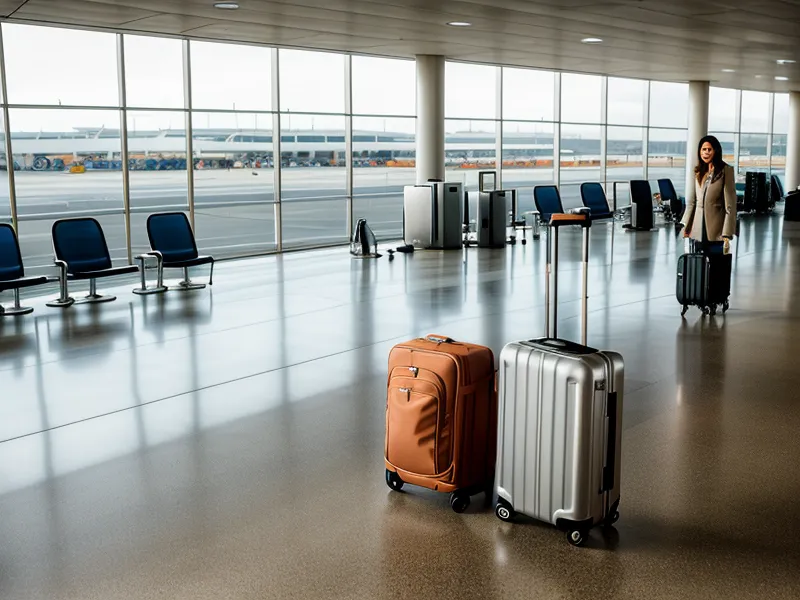
A cheap carry-on and a Briggs & Riley spinner fail the same way on the road: a wheel starts grinding, then locks up completely. The durability difference shows up in what happens next, not in the breakdown itself. One bag gets quietly retired behind a closet door. The other gets boxed up and shipped off for a luggage repair that most business travelers assume is just marketing until they actually need to use it.
The cheap bag in that comparison was a budget spinoff version of a line that otherwise had a decent reputation, and it lasted about five months before the wheels started grinding like a shopping cart with a bad caster. I could still pick it off the baggage claim belt without needing a ribbon tied to the handle. It had that faint cold-storage chill clinging to the shell every time it came around, the kind that tells you a bag just spent an hour in an unheated cargo hold. Looks aside, once a wheel starts grinding on a hardshell like that, there's no warranty conversation to have. You just replace it.
Quick disclosure before any of this goes further: this site runs on affiliate links, and if you buy a bag or a shipping service through one of them, I get a small commission at no extra cost to you. I don't take review units and I don't get paid to say nice things about anything. Everything here is gear I've either beaten up myself over years of every-other-week flights or picked apart until I was sure how it actually held up. My job pays for the flights; my family's trips depend on the same bags not falling apart somewhere in a parking lot. That's the only incentive structure worth mentioning here.
The Briggs & Riley Warranty Only Matters the Day Something Breaks
Every premium luggage brand says some version of "we stand behind this bag," and most of the time that promise evaporates the second a baggage handler gets involved. Brands love to call wheel damage "incidental travel damage" and leave you to replace the bag on your own dime. Briggs & Riley is one of the few that built its whole pitch around not doing that, with a repair policy that explicitly covers handler damage, not just factory defects. I'd flown with mine for eleven years without ever actually testing that promise, which is a strange thing to admit about a bag I'd been loudly recommending to coworkers the entire time.
My first move was embarrassingly analog. I spent a stretch digging through a filing drawer for an old receipt before it occurred to me to just check the website, where it turns out proof of purchase isn't required at all. If the bag is theirs, they fix it, full stop. That's a strange thing to run into in an industry built on fine print, and it felt less like customer service and more like handing your car to a mechanic who still remembers you by name.
The bag itself is built from ballistic nylon, the same basic material family used in old flak jackets, and none of that fabric had actually failed. The wheels and the handle assembly had simply worn out from doing their job for over a decade. Think of the whole bag less like a showpiece and more like a sedan you drive to the office every day: nobody takes a picture of it, but it has to start every single morning, and it has to fit the standard 22 x 14 x 9 inch domestic carry-on box without me negotiating at the gate.
Is a Factory Luggage Repair Actually Worth It for Business Travel?

Once I decided to actually use the warranty, the choice came down to two routes: find a regional authorized repair center, or box the bag and send it straight to the factory. My local option had a backlog long enough that it stopped being realistic, so the factory route won by default. That's worth knowing going in — the "free" repair isn't instant, and anyone picturing a same-week turnaround is going to be disappointed.
Packing a 22-inch suitcase into a box for shipping turns out to be its own small logistics puzzle — you need something sturdy enough to survive a freight truck but not so heavy it triples the shipping cost. I ended up flattening a box that a kitchen appliance had shipped in, which worked fine once I reinforced the corners. Taping it shut, I caught myself wondering if whoever opened it on the other end would notice the coffee stain still faintly visible in the lining from a rough flight a few years back. Shipping off a bag you've used that much feels oddly personal, like mailing someone your diary and trusting they'll be gentle with it.
Why Your Spinner Wheels Keep Failing After a Year of Business Travel gets into the mechanics in more depth, but the short version for mine was carpet fiber and road salt working into the bearings until they finally seized on a jetway transition. I dropped the box at the shipping counter and switched over to my backup bag, a plain hardshell I normally only trust for short overnight trips.
The Shipping Window That Assumes You Have a Front Porch

Sending a bag away for weeks assumes something that doesn't hold true for everyone: a stable address where a box can eventually land. My neighbor Denny, who spent years in logistics consulting before he went fully remote, pointed out that half the warranty programs in this industry are built around a customer who isn't actually moving much. He's not wrong, and he'd know — his garage apparently holds more suitcases than he's ever admitted to owning, tucked in behind the gardening equipment where his wife won't ask questions.
A reader named Clifton Pryke made a similar point when he wrote in — he works in pharmaceutical sales and ships his sample cases ahead of himself with a service like Luggage Forward rather than checking them, specifically because his schedule can't absorb the kind of downtime a mailed repair requires. For someone living out of hotel rooms with no fixed address to receive a box, that door-to-door shipping solves a different problem than mine, but the underlying issue is the same: repair and shipping both assume you can sit still long enough for something to reach you. If a stable mailing address isn't realistic, a Travelpro with easy-to-source replacement parts is a more practical fit than a bag that has to go back to a factory.
Going without my main bag for that stretch also made it obvious how much I'd leaned on the CX-2 compression system without ever thinking about it — my backup hardshell was a fixed volume, full stop, while the Briggs & Riley gives you a few extra inches of depth you can zip back down flat once you don't need them. I get into that compression system in a lot more detail in This Briggs and Riley Suitcase Still Works After Years of Travel, but losing access to it turned every Sunday-night packing session into a genuine space negotiation.
Testing the Repair's Durability Against a Real Travel Schedule

When the box finally landed back on the porch, I'll admit to a genuine flicker of relief over a piece of luggage, which is a slightly pathetic thing to feel but there it is. Inside, the bag looked almost exactly the same — same scuffs, same slightly faded corner — except all four spinner wheels and the entire telescoping handle assembly had been swapped out, including the wobble in the handle I'd quietly been ignoring for longer than I should admit.
The real test wasn't the wheels looking new, it was the first time I packed the bag and heard the internal compression bars click back into their flat position with that same solid, mechanical sound I remembered. Small detail, but it's the kind of sound that tells you a bag is built to go another decade of getting shoved into overhead bins by people who treat "gently" as a polite suggestion rather than an instruction.
Most gear in this price range is designed to get replaced the moment something small breaks, and there's something almost old-fashioned about a brand that would rather repair a decade-old bag than sell you a new one. It's the difference between a nonstick pan you replace every year or two and a cast-iron skillet you just keep cooking on — one is a purchase, the other is closer to an investment you maintain.
None of this means everyone needs to spend premium money on a suitcase. If you fly a couple of times a year for vacation, a budget bag is a perfectly reasonable choice — just go in knowing the wheels are a wear item, not a lifetime promise, and budget for replacing the whole bag once they go. But if you're flying every other week the way I am, and the idea of researching a new carry-on every year sounds exhausting, the repair program is where the premium price actually earns itself back — it's the difference between retiring a bag and simply fixing the two parts that wore out. You can look at current pricing and the different frame styles at the Briggs & Riley store if you want to see whether one fits how you actually travel.