I'm on my knees by the west window in the spare room, working a cracked wheel axle free of its housing, when Denny's truck turns into the driveway two houses down and idles there while he finishes something on his phone. That's usually a carrier's baggage policy page, cross-referenced against whatever regional jet is flying that route this month — Denny keeps a running spreadsheet of which hubs enforce carry-on sizing and which ones wave everyone through, and he updates it after every trip like it's a second job. It's a good reminder of the actual problem with garment bags for business travel and regional flights: the bag that survives a mainline route out of a big hub is not automatically the bag that survives a CRJ into a satellite terminal, and the luggage-durability conversation nobody has is the one about what specifically kills a bag on those smaller planes.
Quick disclosure before any of this gets specific: this site runs on affiliate links, including the ones below for Travelpro, Briggs & Riley, LEVEL8, and Luggage Forward. Clicking through costs you nothing extra and pays me a small commission if you buy — which is roughly how a spare bedroom in a suburb south of Indianapolis ended up with a pegboard of salvaged wheel axles and zipper pulls on one wall and a rolling rack of test bags waiting on the other. I only recommend what's actually made it through a real travel schedule, gate-checks included.
The Overhead Bin Doesn't Care About Your Business Travel Schedule
Regional jets are where garment bags go to get humbled. The overhead bins on a regional jet — the CRJ-200s and ERJ-145s that make up half of a typical regional account manager's month — run noticeably shallower than what you'd find on a mainline 737 or A320, and plenty of them can't take a standard carry-on at the official 22 x 14 x 9 inch limit even when the bag is perfectly within spec. The exact bin dimensions by aircraft type, and which airlines actually enforce them at which hubs, is a deep enough rabbit hole to deserve its own article — ask Denny about his spreadsheet sometime — but the short version is that on these routes, "carry-on" quietly turns into "gate-check and hope."
Gate-checking is where the cheap bags die. Picture a wheel like a knife in a kitchen drawer. A dull one still cuts, right up until it meets real resistance, and then it just fails outright. I ran a sale-rack Samsonite hardshell from an outlet store years back that looked perfectly fine on the shelf and then split clean along a corner seam after about eight months of ramp-crew treatment, which taught me more about garment bags for business travel than any spec sheet ever has. If you're tired of replacing bags on that same schedule, the only carry-ons still rolling after a season of that abuse are worth a look before you buy anything else.
How a Garment Bag Actually Keeps a Blazer Flat on Regional Flights
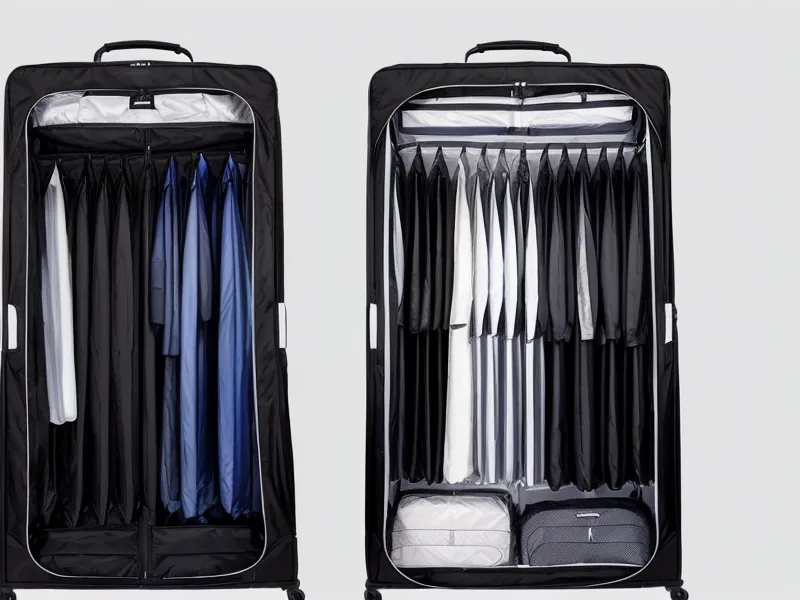
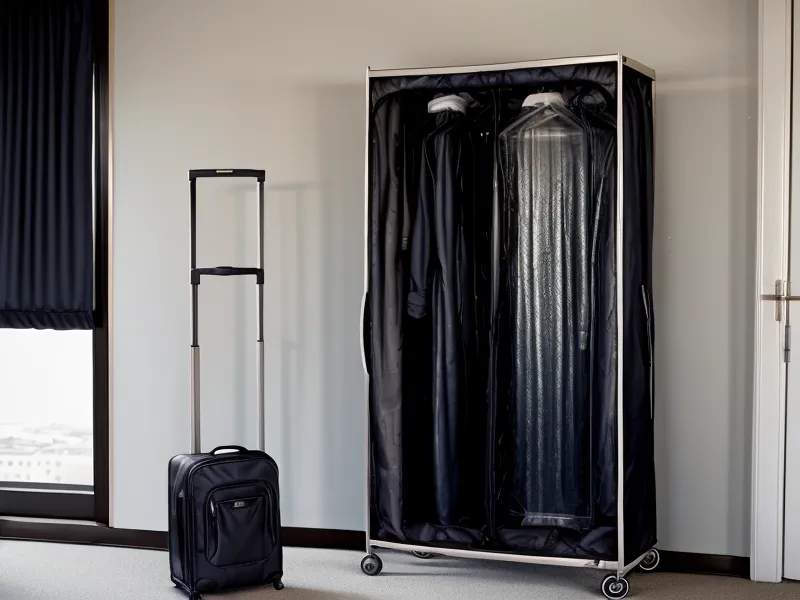
A garment bag protects a suit through structure, not magic — the internal frame and the fold-over hanger setup are what keep a blazer from turning into a wadded mess by the time you land. Fold the jacket over the built-in hanger bar with the shoulders squared, let the bag's internal straps cinch the fabric flat against the frame, and the whole thing behaves like a portable closet: the clothes hang the way they would in a bedroom, just horizontal and strapped down for the trip. That structure is also exactly what eats your overhead bin space, because a rigid frame doesn't compress — it either fits in the bin or it doesn't, no negotiating. A flexible, foldable garment bag trades away some of that hang-flat protection for behaving more like a soft-sided duffel: it'll survive being wedged into a shallow regional bin, but the suit inside will probably want a quick steam once you're at the hotel.
That's a different argument than hardshell-versus-soft-side carry-ons in general, which is its own long-running debate I've hashed out elsewhere. It's also worth saying that how you pack everything else around the folded suit — shoes, a dopp kit, the rest of a three-day rotation — is a whole separate system, and garment bag or not, a sloppy pack job undoes half the benefit of a good frame.
Travelpro or a Structured Frame: Picking Your Regional Workhorse
For someone flying regional routes every week or two, the Travelpro Maxlite 5 has become the bag I point people toward first. It weighs a genuinely light 5.4 pounds, which matters more than it sounds like it should when you're jogging down a connector in Detroit with fifteen minutes between gates — every extra pound in your hand turns into a real ache by the time you hit the moving walkway. Travelpro also happens to be a brand a lot of flight crews carry, which is about as close to real-world torture testing as luggage gets, and the lineup includes sturdier, pricier tiers above the Maxlite if you eventually want more structure without switching brands entirely. Being soft-sided is the whole point here — it has enough squish to survive a grumpy gate agent's sizer and a rougher toss into the belly of a CRJ than a rigid case would tolerate.
When the Gate Agent Wins Anyway
Some jobs require stepping off the plane straight into a client meeting, and that calls for more structure than an ultralight bag offers. This is where the Briggs & Riley Baseline earns its keep — it's built like heirloom furniture, heavier and more over-engineered than it strictly needs to be, in the best way. The CX expansion system adds a few extra inches of depth when a trip runs longer than planned, without the zipper feeling like it's straining, though I wouldn't lean on that expansion space every single trip. The real reason people buy into this brand, though, is the warranty. I've written up the Briggs and Riley lifetime warranty in detail elsewhere, and the short version is that they fix airline damage without a fight, which changes the math on an expensive bag considerably.
Structure is also exactly why a bag like the Baseline gets flagged for a mandatory gate-check more often on smaller planes; the frame that keeps a blazer crisp is the same frame that won't compress into a shallow regional bin. What repeated gate-checks actually do to a bag's wheels and zippers over time is a bigger conversation than fits here, but the one time it mattered most for me was a tight connection where the gate agent tagged my bag without asking, and I watched from the jet bridge window as a belt loader driver tossed it onto the pile like it was a duffel, and the zipper didn't so much as hesitate. A reader named Clifton Pryke, who emails me every so often, keeps a log of wheel failures sorted by the kind of flooring at each airport, and it lines up with what I've seen: some floor surfaces are noticeably harder on wheels than others. Zipper construction is its own rabbit hole too, coil versus molded-tooth is a real difference, and if one ever jams mid-trip, there's a way to work it loose without forcing it, though that fix deserves its own walkthrough rather than a rushed paragraph here.
Skipping the Fight: Shipping Instead of Carrying
Sometimes the schedule is tight enough that even a few minutes waiting for a valet-tagged bag at the jet bridge will cost you the ride you booked, and in those cases I've just skipped the carry-on fight entirely. For multi-city stretches where I'm changing hotels every day or two, Luggage Forward has saved more than one trip — you ship the bag from home straight to the hotel, so there's no bin fight, no repacking liquids into a quart bag, and no wrestling a garment bag in an airplane lavatory. Whether that math actually works out depends heavily on the trip: it makes sense for oversize gear or multiple pieces and stops making sense for a single carry-on flyer on a short domestic hop, since checked-bag fees would usually come out cheaper. The other detail worth knowing before you ship anything is what happens on the receiving end — a hotel front desk isn't always set up to log and hold a package correctly, so confirming that ahead of time is its own small skill worth learning separately.
Where the Aluminum Middle Ground Fits
For a traveler who wants something between the utilitarian look of Travelpro and the buttoned-up look of Briggs & Riley, LEVEL8 hardshells land in a solid middle spot. Their aluminum-frame models get you close to a boutique metal-case aesthetic without the boutique price tag, and the wheels roll noticeably quieter across hotel-lobby tile than most bags in that range — no rumble announcing your arrival to the whole floor. Aluminum construction is a different animal from the polycarbonate shells most hardshells use, and that's a deeper topic than fits here, but the practical version is simple: aluminum dents and stays dented rather than flexing back into shape, so a scuff on a soft-side Travelpro reads as a battle scar while a dent in an aluminum case reads as a permanent souvenir of one bad flight.
The Durability Verdict Across Four Bags
Line all four up and the decision rule is fairly simple. If you're flying regional jets on a tight rotation, the Travelpro Maxlite 5 is still the one to grab first — it's light, parts are easy to replace if a wheel eventually goes, and it fits into bins that reject bigger bags outright. Reach for the Briggs & Riley Baseline when the trip ends in a boardroom and the suit needs to look untouched, accept that it'll get gate-checked more often because of its own structure, and lean on that warranty when the airline inevitably bangs it around. Choose LEVEL8 if you want the aluminum look without the aluminum-brand price, as long as you can live with a dent instead of a scuff as your first sign of wear. And skip carrying anything at all — hand it to Luggage Forward — when you're bouncing between cities every day or two and the shipping math actually pencils out for what you're moving.
None of this is about finding the bag with the most features bolted on — it's about matching a bag's structure to how often you'll actually get gate-checked on your specific routes, and buying accordingly instead of guessing. If you're still torn between the two workhorses in this lineup, my full Briggs and Riley vs Travelpro comparison walks through exactly which philosophy fits which travel frequency, and it's worth five minutes before you spend money on either one.