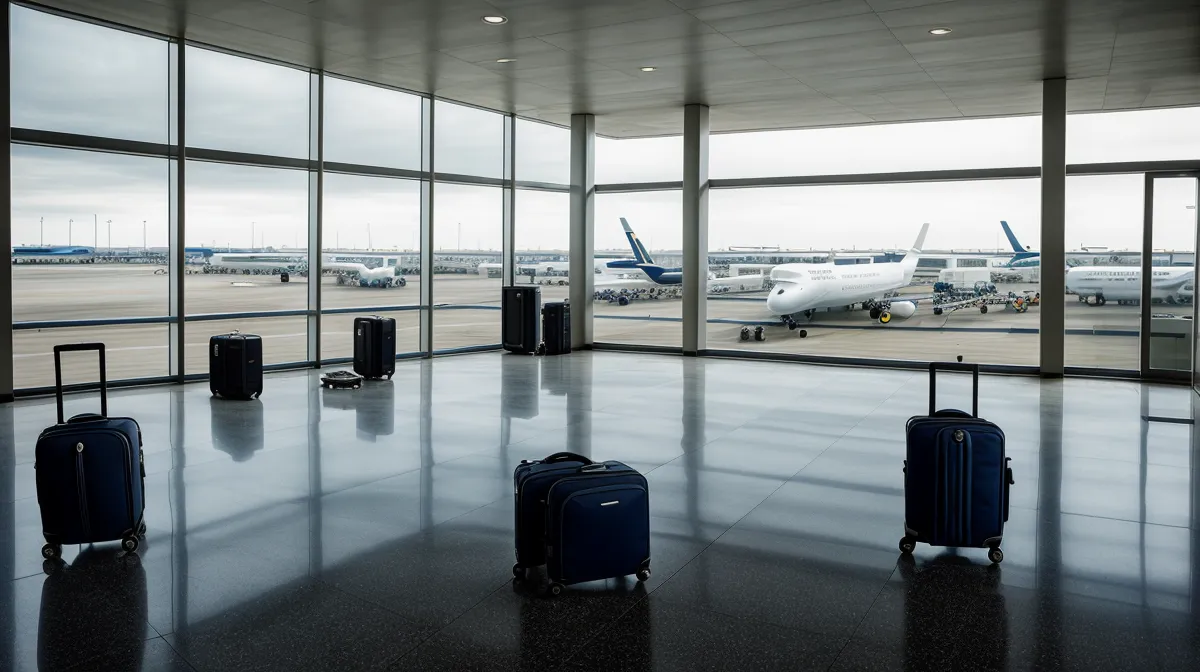
The specific hollow 'thump' of a heavy hardshell hitting the metal carousel is a sound I can hear in my sleep. It is usually followed by the faint smell of jet fuel lingering on the polyester lining and the realization that I still have a forty-minute drive back to my suburb in Indianapolis. It was mid-November, late at night, and I was watching the same three unclaimed bags circle for twenty minutes while my knees ached from a four-hour flight. I realized then that my bi-weekly schedule had turned travel into a logistical nightmare that even the best carry-on could no longer solve.
This site uses affiliate links. If you buy luggage or a shipping service through these links, I earn a commission at no extra cost to you. I only recommend things I have actually put through the wringer myself, from overstuffed spinners to the services that carry them. Transparency is the only way this works, so you can read my full policy here.
The Breaking Point of the Every-Other-Week Flyer
For over a decade, I have lived by the 22 x 14 x 9 inches rule. It is the holy trinity of domestic travel, the standard domestic carry-on size limit that determines whether you get to go home when the plane lands or whether you spend thirty minutes standing in a drafty terminal waiting for a machine to spit out your property. But last year, my territory expanded. Suddenly, I wasn't just carrying a laptop and three days of shirts; I was hauling heavy sample cases and display kits for regional trade shows.
I love my Briggs & Riley for solo runs, but no amount of CX-2 compression can make a display kit fit into an overhead bin. I tried checking the bags, but the 'gate check lottery' is a losing game. You hand over a bag built for a carpeted hotel hallway and it comes back looking like it was dragged behind a tractor. After one too many nights watching the carousel in a daze, I decided to test out Luggage Forward for a major industry conference in Denver. I needed three suits and a full display kit, and the thought of dragging those through O'Hare felt like a form of penance I hadn't earned.
The Logistics of Letting Go
The concept is simple: you pack your bags, someone picks them up at your house, and they appear at your hotel. It sounds like a luxury for people who own yachts, but for someone whose work pays for the flights and whose marriage pays for the family vacations, it is a calculation of sanity. I started the experiment by looking into the reasons I stopped dragging samples through O'Hare, and shipping seemed like the only logical exit ramp.
There is a learning curve, though. My first attempt at a setup was a bit of a failure. I made the classic rookie mistake of assuming I could schedule a pickup for a Monday morning flight on Sunday night. I quickly found out that the ground transit buffer requires a three-day lead time for most domestic routes. You cannot treat a shipping service like an Uber for your suitcases. It requires the kind of forward-thinking I usually reserve for my quarterly sales projections. If you are a 'pack an hour before the Uber arrives' type of person, this will be a painful adjustment.
One thing that sold me was the Luggage Forward guarantee multiplier. They offer a 200% on-time guarantee. If your bag is late, they refund you double what you paid. In an industry where airlines lose millions of bags and offer you a voucher for a ham sandwich in return, that kind of skin in the game is refreshing. It’s the difference between a contractor who promises to show up and one who pays you if he’s late.
Walking Past the Crowd in Denver
The turning point happened one morning last April when I landed in Denver. Usually, the post-flight ritual involves a frantic power-walk to the carousel to beat the crowd, followed by the shoulder-slumping wait. This time, I walked off the plane with nothing but a slim laptop bag. I felt a strange lightness in my shoulders, the kind you only get when you aren't hoisting a 40-pound bag onto the X-ray belt or fighting for the last six inches of space in an overhead bin.
Walking past the baggage claim was surreal. I saw the stressed parents wrestling three strollers and four suitcases at the ticket counter and thought, 'I would pay almost anything to not be them right now.' I walked straight to the rental car counter, drove to the hotel, and found my bags already tucked away in my room. It felt like I had cheated at travel. No wrestling with the overhead bin gamble, no worrying if my wheels would survive the tarmac. Just my gear, waiting for me.
The Digital Nomad Trap and Short-Term Rentals
While this service is a godsend for my regional manager routes, I noticed a specific hurdle for the digital nomad crowd. A lot of the advice you see online for shipping luggage assumes you are staying at a Hilton with a 24-hour bell desk. If you are living out of short-term rentals or Airbnbs, the logistics get thorny. These travelers often lack a permanent address for reliable package delivery and frequently change locations before a courier might arrive if there’s a delay.
If you’re moving between rentals every two weeks, you don't have a concierge to sign for the bag. You are the concierge. This means you have to be present for a four-hour pickup window and a four-hour delivery window. For a business traveler, the hotel handles the hand-off. For a nomad, it’s a day of your life gone. It’s why I tell my younger colleagues that unless they have a 'base' or a reliable host, they might be better off sticking to a high-quality carry-on like a Travelpro and just dealing with the TSA 3-1-1 liquid rule limit of 3.4 ounces.
When the Math Actually Works
Is it expensive? Yes, compared to a twenty-five-dollar checked bag fee. But once you hit the standard linear inch limit for checked bags—which is usually 62 linear inches—the airline fees start to look like extortion. If you are moving golf clubs, skis, or heavy trade show samples, the price gap narrows significantly. More importantly, you aren't paying for the transit; you're paying for the thirty minutes of your life you get back at each end of the trip. For me, that’s an hour per trip, or twenty-four hours a year. That is a full day of my life not spent staring at a rubber conveyor belt.
- Tier 1: The Carry-On Only Purist. Uses a 22-inch bag and never looks back.
- Tier 2: The Standard Checker. Pays the fee, waits at the carousel, prays the zippers hold.
- Tier 3: The Heavy Hauler. Oversized gear, sports equipment, or multi-week stays.
- Tier 4: The Shipping Convert. Values time over the shipping premium.

Final Thoughts After Eight Months of Shipping
After a particularly long flight in June, I realized I’ve stopped looking at my luggage as something I carry and started seeing it as something that meets me there. It’s like the difference between a daily driver and a road-trip car. My LEVEL8 hardshell is great for a quick overnight to Chicago, but for anything involving gear or family, shipping is the only way I survive. It removes the physical toll of the airport, which, at 41, is a benefit I no longer undercount.
If you are tired of the gate-check lottery and the 'your bag is too big' stares from flight attendants, give Luggage Forward a look for your next big run. It isn't for every trip, but for the ones that matter, it's the best way to keep your sanity intact. You can check out more about when the service is a lifesaver before you commit. Just remember to pack three days early—your future self will thank you when you're walking past that carousel in Denver with empty hands.