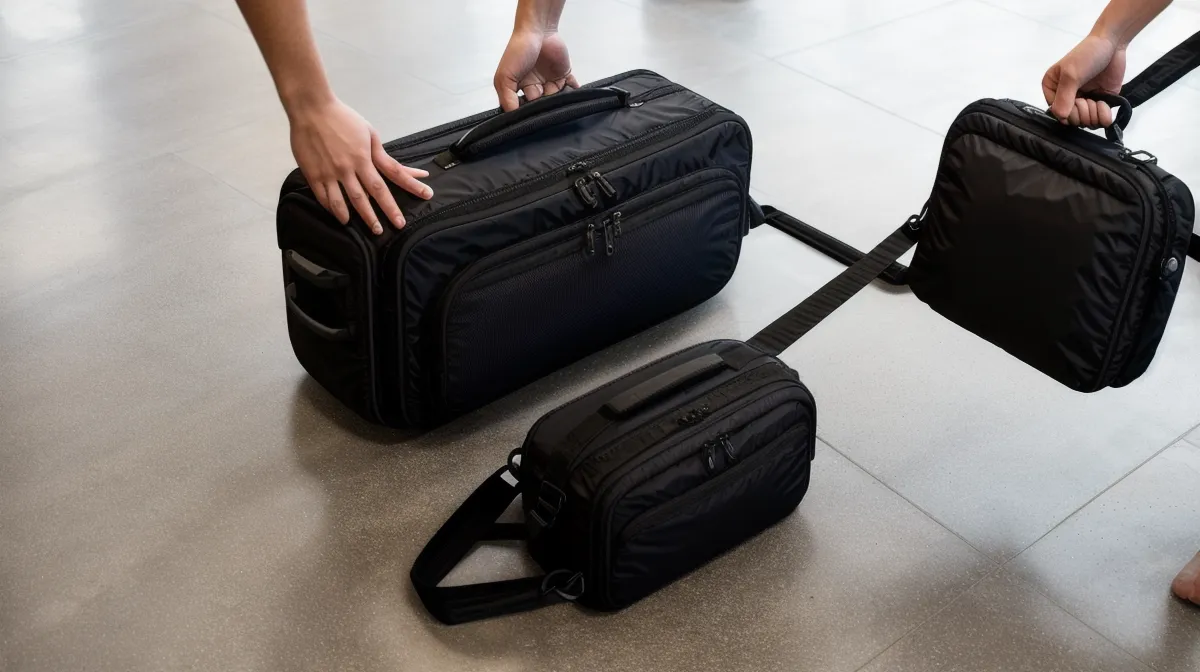
The aisle of a CRJ-200 is not a place for optimism. It is a narrow, dimly lit tube where physics goes to die and where your dignity as a traveler is measured by whether or not you can make a 22-inch bag disappear into a space designed for a briefcase. On an early September morning, I stood behind a guy in a tailored suit who was trying to convince a piece of rigid polycarbonate that it could, in fact, occupy the same physical space as a curved aluminum bin support. He wasn't just pushing; he was using his knee to drive the bag home.
There is a specific sound that happens in that moment—a hollow, metallic 'thunk' of a rigid polycarbonate shell hitting the back of a CRJ-200 bin and refusing to budge a single millimeter. It’s the sound of a hundred-dollar gate-check fee or, worse, the 20-minute wait on a freezing tarmac for a valet bag. As I watched him struggle, I felt that familiar, weary sympathy. I’ve been that guy. But today, my beat-up softside bag was already tucked under my arm, ready to slide in sideways because it knows how to hold its breath.
The Regional Jet Reality for the Every-Other-Week Traveler
If you fly out of a hub like Indianapolis, you quickly realize that the glamorous world of international wide-body jets is a myth. For those of us doing the bi-weekly grind, half our legs are on regional aircraft where the bins are shallow, curved, and seemingly designed by someone who has never actually seen a suitcase. We are dealing with the Bombardier CRJ200 and the ERJ 145, planes that often feature a 1-2 seating configuration. That single-seat side of the plane? It usually has overhead bins so small they wouldn't fit a moderately sized sourdough loaf.
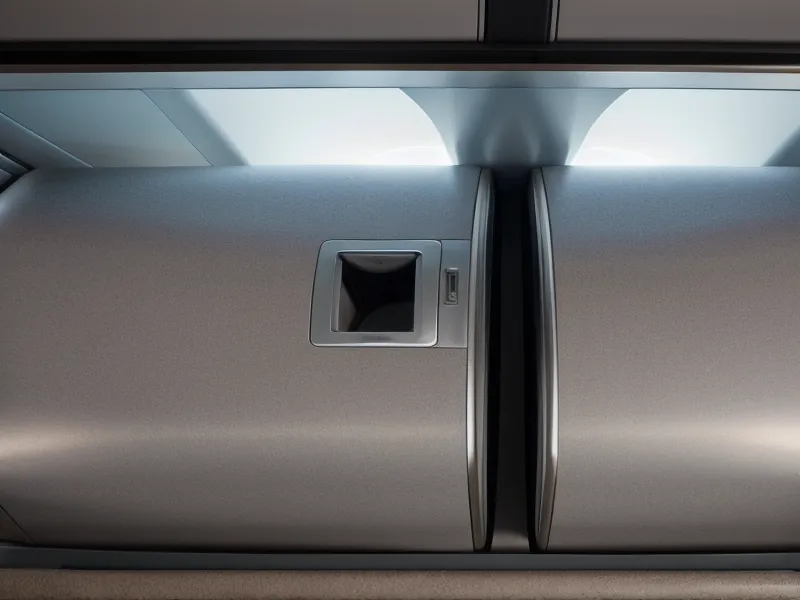
The standard domestic carry-on size limit is 22 x 14 x 9 inches. Most hardside manufacturers build exactly to those specs, or maybe a hair under. But a CRJ200 overhead bin height is often exactly 9.5 inches at its deepest point, and it tapers off rapidly as the ceiling curves. If your bag is a rigid box, it doesn't matter if it’s technically legal; if it hits one of those internal structural ribs or a slightly misaligned latch, it’s game over. This is where the Beyond the Sizer: Why Your 'Standard' Carry-On Might Still Get Checked lesson really hits home. A hardside bag is a commitment to a shape, whereas a softside bag is a suggestion.
Last Tuesday afternoon, I was flying a short hop to Chicago. The bin was nearly full, but there was a gap that looked like a jagged tooth. A hardside bag would have bounced off the opening like a toddler’s shape-sorter toy with the wrong block. Because my bag is built from 1050D ballistic nylon, I was able to compress the front pocket just enough to bypass the latch mechanism. It’s the difference between trying to shove a wooden crate into a closet versus a duffel bag. One has 'give,' and in the world of regional travel, 'give' is the only currency that matters.
The Physics of the Squish and the 1050D Standard
When we talk about softside luggage, we aren't talking about those flimsy gym bags that sag like an old mattress. We’re talking about structured fabric. High-end softside gear uses denier counts that make the fabric feel more like armor than clothing. But even the toughest 1050D ballistic nylon has a microscopic amount of play between the fibers. When you push against a softside panel, the air inside the bag moves, the clothes compress, and the fabric bows inward.
Hardside luggage, usually made of polycarbonate or ABS plastic, is designed to protect its contents by resisting impact. That’s great if you’re throwing it off a cliff, but it’s a liability in a tight bin. If a hardside bag is a millimeter too wide, it’s effectively a mile too wide. You can't compress a shell. I learned this the hard way mid-summer during a heatwave in Charlotte. I was carrying a 'sleek' hardside spinner that I’d bought on a whim because the marketing promised it was indestructible. It was indestructible, alright—it refused to yield even a fraction of an inch when the flight attendant tried to help me close the bin. I ended up with the look of defeat when the flight attendant handed over the yellow valet tag because my 'legal' carry-on was too stiff to fit.
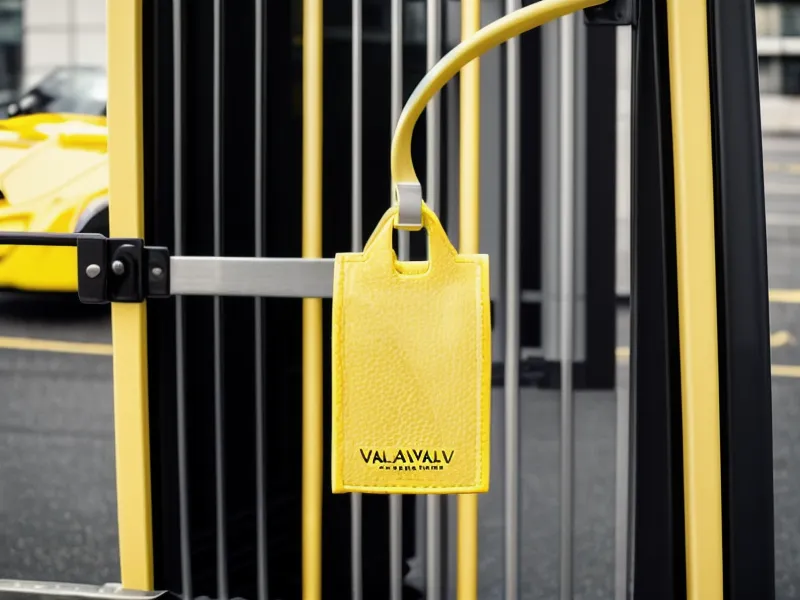
That valet tag is the mark of the amateur. It means you’re going to be the person standing on the jet bridge or the tarmac, sweat dripping down your back in the July humidity, waiting for the ground crew to find your bag while your Uber clock is ticking. Since switching back to a high-quality fabric bag, I haven't had to wait for a valet bag once. I’ve found that this Briggs and Riley suitcase still works after years of travel precisely because it understands that flexibility is a form of durability. It’s the palm tree that bends in the wind versus the oak that snaps.
The Contrarian Trap: Why Softside Can Sometimes Fail You
However, I’m not going to give you the marketing fluff. There is a dark side to softside luggage that most 'travel experts' ignore. Softside luggage actually increases the risk of bin jams on regional jets because its tendency to bulge prevents users from effectively force-compressing it into tight, irregular spaces. This sounds like a contradiction, but hear me out. Because the fabric is flexible, we tend to overstuff the external pockets. We shove a laptop, a charger, a light jacket, and a bag of pretzels into those front zip compartments.
When you do that, the bag 'bloats.' It loses its rectangular profile and becomes a cylinder. On a regional jet, a bloated bag is a nightmare. While a hardside bag is a rigid 'no,' a bloated softside bag is a 'maybe' that turns into a 'stuck.' I’ve seen people wedge a bulging softside bag into a bin, only to realize that the pressure of the bulge is pushing up against the latch from the inside. They get to their destination, and the bin won't open. They’re standing there, yanking on the handle while the rest of the plane is trying to deboard, effectively holding the entire cabin hostage because they over-packed the front pocket.
The trick is to use the softside's flexibility to fit the *internal* hardware of the bin, not to carry more stuff. I think of it like a kitchen knife; it’s a precision tool, not a hammer. If you pack a softside bag to its absolute bursting point, you lose the very 'squish' factor that makes it superior for regional jets. You’ve turned your fabric bag into a rigid, over-pressurized balloon. At that point, you might as well go back to the polycarbonate shell.
Why I’ve Returned to the Fabric Fold for the Long Haul
Late last winter, I sat in the Indy airport during a three-hour de-icing delay, watching the baggage handlers through the window. I watched a hardside bag fall off the cart and crack right down the corner. It didn't just dent; it failed. Meanwhile, the fabric bags just bounced. That was the moment I realized my marriage to hardside aesthetics was over. My work pays for the flights, but my sanity pays for the delays. I need a bag that doesn't just look good in an Instagram post; I need a daily driver that can handle the overhead bin gamble every single Tuesday.
The choice between hardside and softside isn't about which one is 'better' in a vacuum. It’s about the route you fly. If you’re flying Indianapolis to Chicago, or Cincinnati to Detroit, you are going to be on a regional jet. You are going to be fighting for every half-inch of clearance. A softside bag allows you to negotiate with the aircraft. It lets you tuck a corner under a bracket or compress the top just enough to let the door latch click.
After a decade of doing this, I’ve realized that travel isn't about the gear you show off; it's about the gear that disappears into the background. A good softside bag is like a well-worn pair of loafers—it might not have the flash of a new sneaker, but it knows how to move with you. It doesn't fight the bin; it fits the bin. And when you're the first person off the plane and headed toward the rental car counter while the hardside crowd is still waiting on the tarmac for their 'indestructible' bags to be unloaded, you’ll know you made the right call.
The reality is that luggage brands want to sell you on the 'armored' look of hardside shells because it looks great in a studio. But reality isn't a studio. Reality is a 1-2 seating configuration on an ERJ 145 where the bin space is a precious, irregular commodity. For the road warrior, utility will always trump the shell. I'll take the squish over the 'thunk' every time.